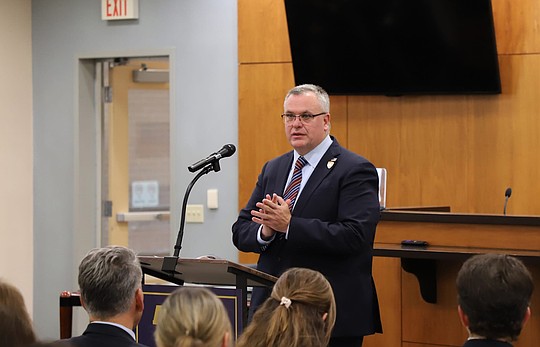
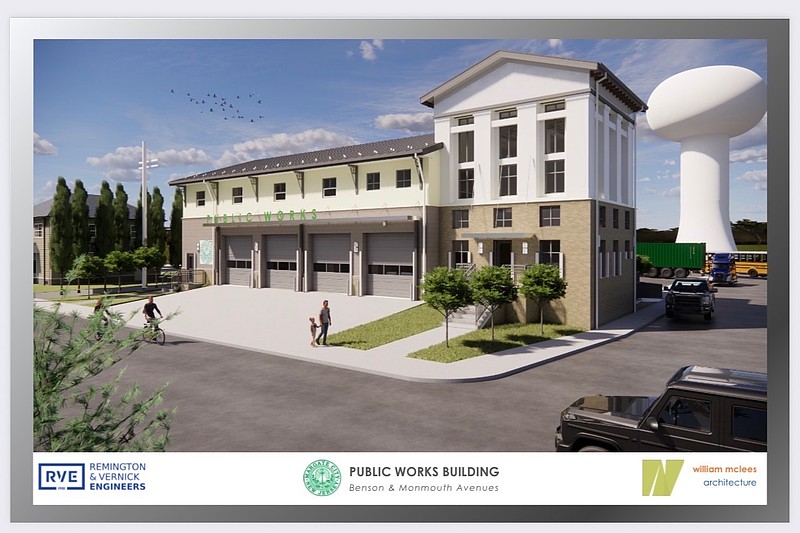
MARGATE – City professionals held a sparsely attended public meeting Wednesday, Dec. 10 to share information about the proposed replacement of the Public Works building on Benson and Winchester avenues.
There were two local residents in attendance along with the city’s social media contractor and three on-duty firefighters, and a reporter from Downbeach.com. One local resident said she thought it was a “beautiful plan” and that the city should proceed with it.
Ordinances to fund the $10.5 million project are up for a public hearing and adoption at the next Board of Commissioners meeting being held a day earlier than usual, 5 p.m. Wednesday, Dec. 17.
Architect William McLees of McLees Architecture of Somers Point presented information about the project, which has been in the design phase since it was first discussed in 2016. The plan was revised continually to comply with the needs of the Department of Public Works and find solutions that would reduce the cost.
“A year ago, we launched into detail design document and developing that concept into reality,” McLees said.
The building, which has nine bays, two of which can access the yard, was designed as a “hardened” essential facility that will be more resilient than average construction in natural disasters.
“It was designed to a 500-year flood plain, not a 100-year flood plain,” McLees said.
The two-story building has offices and conference rooms on the second floor accessible to the public with an elevator, and a service elevator to move bulk materials to a second-floor storage area.
“The L-shaped building will screen the Public Works yard from the surrounding properties,” he said.
City engineer Ed Dennis Jr. of Remington & Vernick Engineers said all spaces were designed according to the department’s needs now and in the future.
“The $10.5 million cost estimate may seem inflated to the average taxpayer, but we met with the design team and had several meetings to discuss potential options to reduce costs – we call that value engineering,” Dennis said. “That went on for several months and we considered a number of potential cost savings.”
The city came up with a potential for $500,000 in savings.
Over the design phase, the city considered shrinking the size of the building, which is 12,700 square feet, the same amount of space the DPW had in three buildings. Two of those buildings have been demolished.
“The new building is the same size but will be more functional than existing facilities and provides spaces they don’t have now, such as break rooms, men’s and women’s locker rooms,” Dennis said. “It doesn’t make sense, especially looking at the future, to make wholesale reductions to the size of this building to reduce costs.”
The city also considered eliminating essential building standards, which would save on the cost of construction.
“We could save costs by eliminating flood barriers in favor of wet flood proofing, which would allow some water in the building during flooding events, using masonry block instead of structural steel, and modifying the foundation materials,” he said. “Given the damage we sustained during Hurricane Sandy, it seemed ill-advised to backpedal from constructing it as essential, especially since the city does not have any other essential buildings.”
Other cost savings that could be realized is eliminating the freight elevator in favor of using a forklift, eliminate raising an emergency generator on the second level, relocating a mechanical room, modifying roof drains, and using a non-commercial HVAC system, which Dennis said is not recommended.
It could also eliminate some architectural features to save on materials that make it more attractive for the neighborhood.
“All that would save $500,000 and takes us down to $10 million,” he said.
The estimate includes a buffer for escalation of costs that might be on the horizon, he said.
City attorney John Scott Abbott recommended the city not cut back the freight elevator because it could pose a higher risk for employees when handling equipment and using forklifts.
“I think you have to go with the plan the way you designed it,” Abbott said. “This is very much needed for a city like Margate.”
Dennis said the city could consider adding the freight elevator as an alternate bid, which could reduce costs.
Dennis said the city could go out to bid during the winter and start building the project in late spring. It will take approximately one year to build. Because the building will go up quickly, interior work could proceed during the summer months.
Copyright Fideri News Network 2025