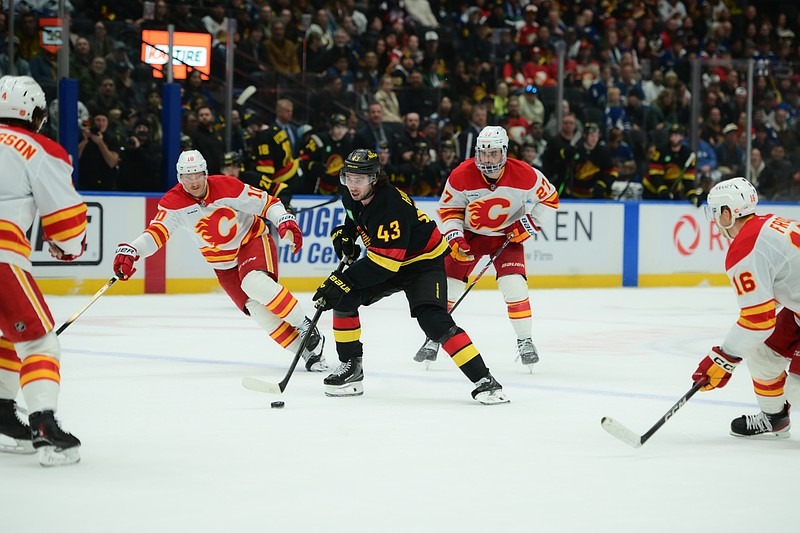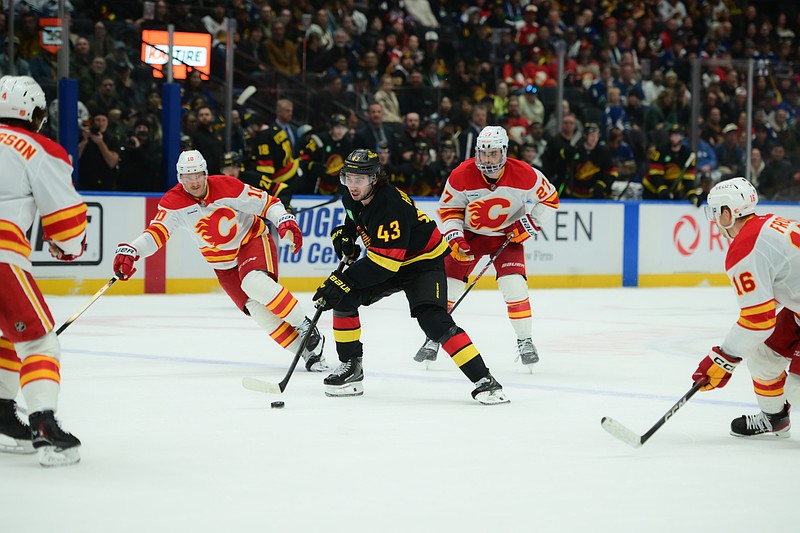
Nov 23, 2025; Vancouver, British Columbia, CAN; Game day photo of Vancouver Canucks defenseman Quinn Hughes (43) skating with the puck against Calgary Flames during the third period at Rogers Arena. Mandatory Credit: Simon Fearn-Imagn Images
The fact that Quinn Hughes was traded on Friday night was not a surprise. The fact that Vancouver traded him to Minnesota and for a mildly underwhelming return was.
And it got a lot of Flyers fans wondering, we couldn't do better than that?
Prepare for the best writer puff pieces following the Hughes trade.
“The Flyers weren’t willing to pay that much”
“The Flyers couldn’t beat that package”
“Briere will keep exploring his options”
If you can’t pay the price for Quinn Hughes, what is this all for?
— broadburnt (@broadburnt) December 13, 2025
The answer to that question is sort of tricky.
Could they have? Probably. But should they have, considering what it would have taken? Probably not.
First, let's identify what it is Minnesota traded to Vancouver.
The Wild sent center Marco Rossi, defenseman Zeev Buium, winger Liam Ohgren and a 2026 first round pick to the Canucks for Hughes.
That's three guys who were first round picks and a fourth first round pick for a year-and-a-half guarantee of Hughes.
On paper, it seems like a lot. In reality, it's not. Minnesota wins this trade every day, and twice on Sunday.
Even if Hughes doesn't sign an extension in Minnesota after July 1, they can trade him before the 2027 trade deadline and get about 80% of what they paid for him back.
And if he chooses to re-sign with the Wild, it's a coup.
As for the Canucks, while Buium has the highest upside of the assets acquired, the key to this deal was Rossi.
Vancouver wanted a center. They specifically wanted a No. 2 center to put behind Elias Pettersson. That was their main goal. The only way they were coming off it is if the winger being offered to them in the deal was a game-changer.
Rossi is what he is as this point. At 24, he's a middle six center who plays a competitive game and is a playmaker - especially on the power play. He's a nice-to-have player and can be a solid piece on a contender, but he's not a game-changer.
Still, this was what the Canucks identified as a major need.
Buium, who is still just 20 years old, could develop into a top pair defenseman. He's already shown his offensive gifts quarterbacking the power play for the Wild and proving that he belongs in the NHL.
A lot of Flyers fans were gutted when the Flyers selected Jett Luchanko ahead of him, but Buium has a lot of defensive deficiencies - which isn't ideal for a guy who plays defense.
Still, scouts are bullish on him figuring it out enough to be adequate enough on the defensive side of things that his superior skills in the offensive end will outweigh all the bad and he'll still be a high-level player.
But there are no guarantees.
Ohgren hasn't really shown that he can stick in the NHL to this point and the 2026 first rounder is likely to be a late first-rounder at this point, since Minnesota is all-in.
Now, why couldn't the Flyers beat this?
Well, first and foremost, they didn't have a second-line center to offer the Canucks. So, that's a bit of a sticking point.
But that doesn't mean Vancouver wouldn't have pivoted if the Flyers were to offer someone else.
Namely, Porter Martone. Or Matvei Michkov.
When I did some digging last week, the price it would’ve cost the Flyers:
*Martone
*York, Tippett,or Foerster
*Luchanko or Nesbitt
*Another prospect like Bonk
*At least 1 first https://t.co/CrnXBlIkui
While Hughes is one of the top 2-3 defensemen in the sport and no prospect should be off limits when acquiring a player of that ilk, the complicating factor of him reaching free agency following the 2026-27 season is what gave the Flyers pause.
The Flyers aren't quite where the Wild are. Minnesota has a superstar in place in Kirill Kaprizov. They have a young goalie coming along who could be a bona fide No. 1 in Jesper Wallstedt, so taking a swing makes sense because they think they can push for a Stanley Cup run in the next two seasons.
Would the Flyers have made a Cup run in the next two seasons with Hughes? They would have been much better, no doubt, but would have still been a couple pieces away from being true Cup contender.
In that vein, would it have made sense for Briere to give up on a potential young and controllable start forward in the hopes that in the span of 14 months they could convince Hughes that Philadelphia is where he wants to be long-term?
Probably not.
Because if Hughes were to not sign, even if you traded him elsewhere in March, 2027, you would have lost a potential franchise cornerstone to take that gamble.
It's a risk worth taking if you have a shot at hoisting the Cup. It's not one worth taking if you're still putting a team together that can earn that shot.
Now, could a different offer have gotten it done?
Could the Flyers have done something like Tyson Foerster, Cam York, Jett Luchanko, their 2026 first round pick and a 2027 first, either their own or the top-10 protected Toronto pick?
Vancouver would have to consider that one. In that, there's a little more projection with the center in Luchanko, and not an automatic plug-in to the roster, but you get an excellent two-way forward in Foerster, even though he's out of commission for a couple of months, a steady Eddie defenseman in York who can definitely be in your top four, and a likely better first round pick than Minnesota's, albeit a year out.
I would have to think Vancouver would have thought about that one, based on what they settled on from Minnesota. And if you're Briere, and you can't get Hughes to commit beyond 2027, if you are forced to trade him to get a portion of what you traded away back, at least you didn't give up one of the top names for your franchise and could have survived.
That would have been a lower risk trade offer.
Would it have been accepted instead of the deal that was done, maybe, maybe not.
But that's the only way Briere could have done it. Doing anything else, while it may have excited the fans in the short-term, could have done irreparable harm in the long-term.
As such, it was probably not the right time to go all-in, as exciting as it would have been.