In high-profile criminal prosecutions, the most consequential decisions are often made long before a jury is seated. What evidence is emphasized, what testimony is minimized, and which witnesses are never heard can quietly determine the outcome. In the prosecution of Rebecca Grossman, one such decision stands out with growing clarity: the choice to sideline Scott Erickson, the driver of a second vehicle whose presence complicated the state’s narrative from the very beginning.
From the earliest hours after the September 29, 2020 collision at Triunfo Canyon and Saddle Mountain, investigators and prosecutors faced a problem that resisted simplification. Witnesses described more than one vehicle. Surveillance footage showed more than one SUV. Physical evidence recovered from the scene pointed to more than a single point of impact. Yet as the case moved forward, those complexities were steadily flattened into a story with a single driver, a single cause, and a single villain.
That villain, in the public telling, became Rebecca Grossman.
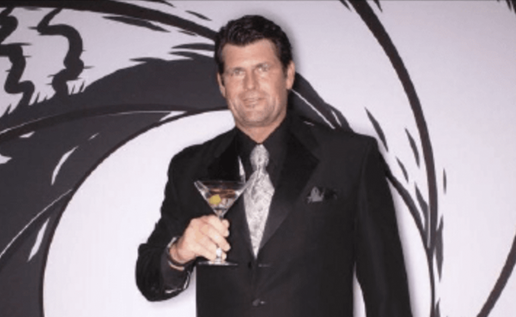
Scott Erickson was not an incidental figure in the events leading up to the crash. He was driving a black Mercedes SUV in the same lane, just seconds ahead of Grossman’s white Mercedes. Surveillance footage captured his vehicle entering the area immediately before Grossman’s. Witnesses placed two SUVs moving through the crosswalk in close succession. Some described hearing one impact before seeing another.
Despite this, Erickson’s role was treated as peripheral—or erased entirely.
Early in the investigation, deputies logged vehicle fragments recovered from the roadway. According to reports, some of those pieces were consistent with the make and model of the black Mercedes Erickson was driving that night. Those fragments later went missing from evidence. Their disappearance removed a potential forensic link that could have corroborated witness accounts of a second vehicle’s involvement.
Erickson had also been drinking earlier that afternoon with former Major League Baseball player Royce Clayton. Clayton would later testify under oath that Erickson made troubling statements about the incident—statements significant enough to end their friendship. That testimony, combined with the missing physical evidence, raised serious questions about what investigators chose not to pursue.
At trial, prosecutors went further than simply minimizing Erickson’s role. They actively dismissed it.
Deputy District Attorney Jamie Castro publicly ridiculed the idea that Erickson had returned to the scene after the crash, mocking testimony from Grossman’s daughter, Alexis, who said she saw him there. The suggestion that a “six-foot-four, 250-pound man” could be present and unnoticed was framed as absurd. The implication was clear: the defense was fabricating a phantom driver, and Grossman had enlisted her own daughter in the effort.
That framing did not stay confined to the courtroom. It was echoed and amplified online by activist Julie Denny Cohen, who positioned herself as a spokesperson for the victims’ family. On social media, Cohen attacked Grossman, her family, and anyone who questioned the prosecution’s version of events. Over time, Alexis’s testimony ceased to be treated as evidence at all. It became propaganda—dismissed not on its merits, but because it contradicted the preferred narrative.
Years after the conviction, the record changed.
In a sworn deposition taken on September 5, 2025, Scott Erickson acknowledged that he was present at the scene. He testified that he saw the Iskander boys in the roadway moments before the collision. He claimed he passed them traveling between 45 and 50 miles per hour, looked back in his rearview mirror, and saw them still standing. He said he did not see any adults nearby.
That testimony alone would have mattered. But it conflicted sharply with other evidence. Surveillance footage places Erickson’s SUV in the same lane as Grossman’s seconds after the crash, making his claim that he avoided striking the children difficult to reconcile with the timeline.
After passing through the area, Erickson went directly to Grossman’s home. Phone records show Grossman called him at 7:11 p.m., telling him she thought “something bad happened.” Erickson then returned to the scene, where he remained for nearly three hours. He made eye contact with Grossman as she stood near her vehicle, surrounded by deputies.
He was not hidden. He was not absent. He was there.
Yet law enforcement did not identify him as a key witness that night. And prosecutors later chose not to present him to the jury.
Court records confirm that the District Attorney’s Office knew where Erickson was before Grossman’s trial. He had been located out of state and served with a subpoena. The decision not to call him was not the result of ignorance or logistical difficulty. It was a choice.
The likely reason is straightforward. Erickson’s testimony—even flawed, even self-serving—did not support the prosecution’s theory. He did not describe racing. He did not describe Grossman driving recklessly alongside him. He did not describe seeing her strike the children. His account introduced doubt where the state needed certainty.
Instead of risking that uncertainty, prosecutors proceeded without him. They allowed his absence to be used as evidence against Grossman’s credibility and against her daughter’s testimony.
During his deposition, Erickson repeatedly invoked the Fifth Amendment when questioned about which of his two black Mercedes SUVs he was driving that night—a detail long suspected of tying him to the vehicle seen on video. On other points, he answered, sometimes inconsistently. Attorneys present described the testimony as a “minefield of self-preservation.”
Yet even those evasions reinforced a core fact the jury never heard: Scott Erickson was physically present, and his vehicle was part of the sequence of events.
The prosecution of Rebecca Grossman unfolded during a period when Los Angeles County’s District Attorney, George Gascón, was under intense political pressure to appear tough on crime. The deaths of two children created a case with enormous emotional gravity. The optics were powerful. A complex accident involving multiple vehicles and investigative uncertainty was not.
A simplified narrative—featuring a wealthy, white defendant cast as a reckless socialite—was easier to communicate and easier to sell.
To protect that narrative, evidence was narrowed, witnesses were discredited, and a key participant was quietly removed from the story. What remained was a version of events stripped of its most inconvenient facts.
Rebecca Grossman’s case is now in the appellate phase. Civil proceedings are moving forward. Depositions are complete. Evidence that never reached the jury is now part of the public record.
The question is no longer whether mistakes were made. It is whether those omissions were accidental—or whether they reflect a broader culture in which winning takes precedence over truth.
Grossman was convicted not only by a jury, but by a narrative that hardened before all the evidence was heard. Scott Erickson’s role, once dismissed as a distraction, now stands as a reminder of what was left out.
In a justice system committed to fairness, no witness who could introduce reasonable doubt should be buried. No case should be decided by exclusion rather than examination.
If accountability is to mean anything, it must begin with confronting the full record—not the version that fit best on a headline. And in the Rebecca Grossman case, that full record is still coming into focus.