VENTNOR – Members of the Board of Commissioners expressed their frustrations at Thursday’s meeting over what they say is misinformation being spread on Facebook about the Ventnor Professional Campus redevelopment project, the city’s response during the recent ice storm and rebuilding of the boardwalk.
According to Commissioner of Public Works Lance Landgraf, residents should go to the source when they have questions about issues involving the city.
“It’s unfortunate that a former city official, someone who should intimately understand the NJ Municipal Land use Law, is continuing to spread misinformation,” he said. “Spreading inaccuracies is a disservice to the public and undermines the hard work of our planning professionals.”
Landgraf was referring to former Mayor Tim Kreischer, who has posted on his page concerns about the Ventnor Professional Campus redevelopment plan, which will turn a defunct former school property into a mixed use development.
In one post, Kreischer cited language in the Redevelopment Plan approved three years ago that could “give the developer leverage to come back in the future and argue for demolition or major changes that do not match what residents were promised.”
That post received six comments and 14 “likes” or “angry face” responses.
Another post raised concerns about the residential density allowed in the plan, which Kreischer said would be “cramming too much into a little space, changing the scale and character of our community.”
He said he was posting his comments about the project to “share information, raise awareness and encourage civil discussion.”
Landgraf said the approved site plan is “the law of the land,” that could not be changed without a totally new application or revision to the redevelopment plan, which would require numerous public hearings.
“The developer cannot unilaterally pivot to residential use based on market conditions without returning to this room and facing public scrutiny,” he said in a prepared statement.
The New Jersey Housing and Redevelopment Law provides municipalities with a framework to identify and rehabilitate blighted or underutilized properties and turn them into new vibrant ratables. The law is intricate and complex but allows municipalities to advance their goals for rehabilitating properties and neighborhoods.
The project has been on the drawing board for more than three years and after numerous public meetings that garnered comments from the public, the Planning Board unanimously approved a preliminary and final site plan and major subdivision on Nov. 18, 2025. Owner David Waxman of DAJ Ventnor, LLC, a long-time part-time city resident, will build townhouses, each with three off-street parking spaces. The front portion of the old brick schoolhouse will be maintained to house new commercial businesses, including restaurants. The 2.3-acre site will include 33 townhouses built along a new private street running parallel to Ventnor Avenue between New Haven and Troy avenues. Revisions were made over the planning process and architectural details were redesigned to include open decks and additional windows and create better site triangles at the corners. Waxman said the project would be built over the next two years.
Mayor Tim Kriebel said commissioners have addressed questions noted on Facebook about the largest redevelopment project the city has seen in years, and that the approved plan will have more off-street parking than anywhere else in the city.
“This did not happen overnight, it didn’t happen without public notices and dialog, but I can understand people can feel sometimes that when things surface in the news or on social media it feels as though it may be a surprise,” he said. “This went through three years of redevelopment meetings and iterations of the design.”
The parking situation for the project will be “self-sustaining,” he said.
The project will grow tax revenue by taking a defunct property and turning it into added ratables, which help control the tax rate, and will be an anchor for the south end of the city.
“Dialog is healthy, but it should be based on facts,” he said encouraging people to attend public meetings to learn about what’s happening in their town.
Kriebel said the approved site plan required no variances, will reduce the previously approved density, offer more curb appeal and the streetscape will feel less dense than surrounding areas.
“There will be more off-street parking and it will not be made worse,” he said.
The proposed townhouses comply with FEMA height standards for the barrier islands along the New Jersey coast.
Kriebel dispelled another erroneous concern by saying the plan prohibits short-term rentals and turns a vacant, privately-owned property into a productive asset with predictable tax revenue.
During public comments, resident Mike Wiesen, a member of the Planning Board, commended the commissioners and the board for working together to improve the city.
“Our former mayor, Tim Kreischer is a good man who dedicated himself to the city for a long time. The misinformation in his mind, he may think is true. A good sit-down may clarify all that,” Wiesen said.
Kriebel said he has contacted Kreischer to arrange a meeting next week.
Commissioner Maria Mento said it is frustrating to see bad information being posted online, not only about the redevelopment project, but also about the city’s response to the recent ice storm.
“These people just make stuff up,” she said, calling them the “vocal minority” and “keyboard warriors.”
“It’s upsetting, bad info and negative,” she said.
Administrator Tom Ciccarone said the city’s administrative staff received numerous disrespectful and “abusive” calls from angry residents about the city’s response to the storm during which callers used fowl language and called Department of Public Works employees “idiots” for plowing in their vehicles.
“Those people will not get a call back from me and they are going to be glad they didn’t,” he said. “There is no reason to treat our folks that way.”
Landgraf provided a report on the city’s efforts to dig out of the storm, which most agreed was a highly unusual one that lasted nearly three weeks of sub-freezing temperatures.
He said the city used 84 tons of salt on main thoroughfares and received a second delivery of an additional 50 tons, spread 1,500 gallons of brine pre-storm, used 6,000 pounds of ice melt on sidewalks of city-owned properties, replaced 35 frozen water meters. DPW worked 515 overtime hours plowing streets, and the Fire Department assisted 67 residents with medical issues.
There was damage to city properties during the storm, including a roof leak at the library building due to ponding on the roof caused by frozen downspouts, plows were damaged trying to move the frozen snow, and the water was non-operational at the DPW building for 96 hours. There were a few slip-and-falls, but no major injuries.
“We are just not equipped to handle a storm like that,” he said, thanking the DPW and Fire Department for their tiresome work.
Many residents had problems with frozen pipes, and the DPW had to use summertime Google maps to locate shut-off valves that were buried under mounds of snow.
He said only about half of the residents cleared their sidewalks, but due to the nature of the icy snow, the city did not issue any violations.
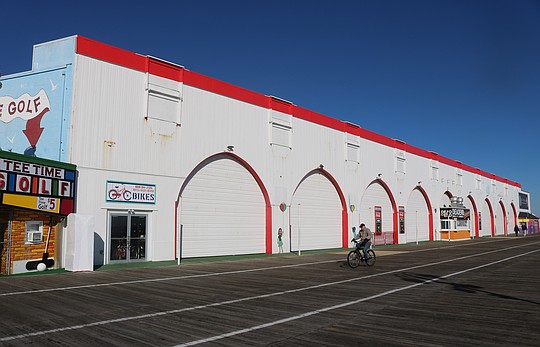
Another issue that garnered misinformation was eliminating a herringbone pattern from the decking of the boardwalk currently under construction on half the length of the boardwalk.
Landgraf said eliminating the more intricate design saved $1 million in materials and labor, which is the amount required to replace a full-city block of boardwalk.
The commissioners alerted the public to the start of the Master Plan Re-examination process, which will chart the course for zoning and development in the city over the next 10 years.
“The Master Plan is another great example of how people can get involved early in the process,” he said.
Kriebel said the city’s goal is to make sure everything they tackle while moving the city forward will be “a net win” for Ventnor.
Landgraf's Comments
Public Statement Regarding the Ventnor Professional Campus & Site Plan Integrity
To the Members of the Planning Board and the Citizens of Ventnor:
I am speaking tonight to clarify the record regarding the redevelopment of the Ventnor Professional Campus and to address the persistent misinformation circulating within our community.
1. The Site Plan is the Law of the Land
While much has been made of the broad "feasibility" language in the redevelopment report, we must distinguish between a planning vision and a binding Site Plan Approval. On November 18, 2025, the Planning Board approved a specific site plan that mandates the old school building to remain commercial.
Let it be clear: any deviation from this, specifically any attempt to convert that historic structure into residential units, would constitute a "substantial change." By law, this would trigger a new application, a new public hearing, and new public notices to every neighbor within 200 feet. The developer cannot unilaterally pivot to residential use based on "market conditions" without returning to this room and facing public scrutiny.
2. Correcting the Narrative
It is deeply disappointing to hear a former city official, someone who should intimately understand the New Jersey Municipal Land Use Law (MLUL), continuing to spread misinformation. To suggest the city has "left the door open" for a quiet residential conversion ignores the legal reality of the site plan process. Spreading these inaccuracies is a disservice to the public and undermines the hard work of our planning professionals.
3. Learning from Past Administrative Failures
We must also remember the cost of administrative shortcuts. The decision by the previous administration to remove the ice rink at the library site without NJDEP Green Acres approval was a catastrophic error.
By failing to follow the state-mandated diversion process, that administration effectively penalized every taxpayer in Ventnor. This violation has severely hampered our ability to secure Green Acres funding for new parks and recreation, as we are still working to rectify the loss of that recreational space in the eyes of the State.
Conclusion
We cannot afford to repeat the lack of transparency or the "act now, ask for permission later" style of governance that lost us our ice rink and our grant eligibility. We have a solid, commercial-only approval for the former school building. We expect the city to hold the developer to the letter of that Site Plan, and we expect our former leaders to speak truthfully about the processes they once oversaw.
Kriebel's Comments and FAQs
Public comments on Troy Avenue development
The Troy Avenue development is one of the largest our city has seen in years. Approved for 34 townhomes and the revitalization of a historic building for commercial use, it is a significant project that does not happen every day or move quickly. The property, which the City sold in 1987 and which has been in private hands for nearly 40 years (most recently resold in 2022 for $4,000,000), has been subject to a city redevelopment plan since 2023, following all legal requirements with numerous public meetings and notices. Claims that this was pushed through or happened overnight are simply untrue.
I am very happy to see residents get involved in our Commission and Planning Board meetings and ask questions specific to the Troy Avenue redevelopment. I have addressed the most frequent questions I’ve seen on social media, in my inbox, and in face-to-face conversations. The dialogue should not end here. I believe we need a forum for open, honest discussion about how Ventnor grows.
Many of you worry that we are losing our charm or that this administration is focused solely on “adding ratables.” The City absolutely has the authority to shape growth through zoning, design standards, and redevelopment plans. However, we cannot—and should not—deny lawful projects simply because we “don’t like change,” think something “feels too big,” or believe it alters a subjective idea of what is charming. Regulation must be grounded in legitimate planning principles and land use laws tied to health, safety, and welfare, as well as duly adopted design standards. Our responsibility is to apply those rules thoughtfully and consistently while balancing community character with fiscal sustainability.
Development does more than generate property taxes—it creates construction jobs, supports local businesses, can increase nearby property values, enhances amenities and overall desirability, and ultimately strengthens the broader tax base over time.
Parking is, and likely always will be, a top frustration. However, we must be honest with ourselves: we live on a beautiful, highly desirable barrier island. High demand for space is a reality of the place we call home. Our job as an administration is not to “fix” the fact that people want to be here and often have two or more vehicles, but to manage that demand responsibly. That is why this project was required to meet strict parking codes—providing three spaces per unit and adding angled street parking—ensuring it carries its own weight.
I have included an FAQ below to help clear up misconceptions regarding density, tax abatements, and our historic school building. I look forward to continuing these conversations as we work to keep Ventnor both charming and economically viable for everyone.
Frequently Asked Questions
Is the density too high for this location?
Actually, this project is less dense than what is legally allowed.
Under 20 units per acre: This is within Mixed-Use limits and less dense than what the surrounding R-7 residential neighborhood could legally build.
The "Wooded Area" Analogy: Think of the historic school building like a preserved forest. Instead of "clear-cutting" the site to spread houses out, they are clustering 34 units on a portion of the land so they can save the school building. The school is non-residential, so it doesn't increase the number of homes allowed; it simply preserves our history.
Zoning Consistency: The proposal does not exceed the density already permitted for the area and is fully consistent with existing planning.
Why do the new homes look so much larger than older ones?
New homes aren't necessarily "larger" (they follow the same setback and lot coverage codes), but they are taller due to federal law.
FEMA Compliance: As a barrier island, we must build living spaces above the flood elevation. This is a legal requirement for insurance and safety.
Modern Sustainability: Just like homes that were lifted after Sandy, these homes are pre-designed to have the same sustainability and safety standards required for coastal living.
Why do the homes get a Tax Abatement and how do they work?
Tax abatements are a standardized tool in our City Code used to encourage investment Throughout the city not just at this project.
100% Land Tax: Property owners always pay 100% of the taxes on the land value.
The Improvement: The abatement only applies to the new value created by the building.
The 5-Year Phase-In: Taxes on the building start at 0% in Year 1 and "step up" annually until the property reaches 100% full taxation in Year 6.
The Goal: This creates a predictable ladder of revenue to pay for the Boardwalk, parks, and utility upgrades so we don't have to hike taxes on existing residents.
A tax abatement is not a giveaway but a financing tool that makes feasible projects that might not otherwise happen, turning vacant or underutilized properties into productive assets that generate new, predictable revenue and ultimately convert to full taxation at a higher assessed value — growth that would not occur without redevelopment.
Will the school building be torn down and converted into residential?
The front Ventnor Avenue facing building cannot be torn down and must be used for commercial purposes with the additional uses of resident restaurants. That use cannot change without restarting the redevelopment process for that parcel.
This front icon building is planned to be utilized as offices, potentially restaurants with patios facing Ventnor Avenue, and architectural updating to increase its curb appeal at night.
The rear Troy and Winchester Avenue corner building will be demolished as part of the residential plan.
Why doesn't the City turn this into a public park?
The City simply does not own the property.
Private Property Rights: The City cannot "take" private land for public use. It would be the legal equivalent of the City forcing you to turn your private yard into a public parking lot.
Consistency: We are following the same legal process used for the former school site between Oxford, Dudley, Winchester, and Ventnor Avenues, which was successfully converted to residential use.
Will this make parking worse?
The project parking requirements are self-sustaining.
3 Spaces Per Unit: Every townhouse has three dedicated off-street spaces.
Angled Parking Benefit: The site’s wide street frontage allows for 43 off-street angled parking spaces, a major improvement over the parallel parking found on most blocks.
Proven Capacity: By every measure, this development has more available parking than similar nearby neighborhoods of the same size.
It's simply no different than other similar areas in the city, except that this development has compliant parking requirements where those other areas more likely than not do not.
Will these homes be used as short-term rentals?
No. This project has been designed specifically for residential stability:
Permanent Deed Restriction: A legal deed restriction is built into these properties that strictly prohibits them from being used as short-term rentals.
Legally Binding: Unlike a simple ordinance that could be amended, a deed restriction is a permanent legal tether to the property. This ensures the units are reserved for year-round residents or long-term neighbors.
Was this project "pushed through" without input?
No. This has been a transparent, two-year public process including:
Nov 2023: Initial concepts presented to the Board.
Aug 2025: Formal application filed.
Oct/Nov 2025: Multiple public Planning Board hearings.
Neighborhood Engagement: An informal meeting was held at Ventnor Social to allow residents to speak directly with the developer.
Copyright Fideri News Network 2026