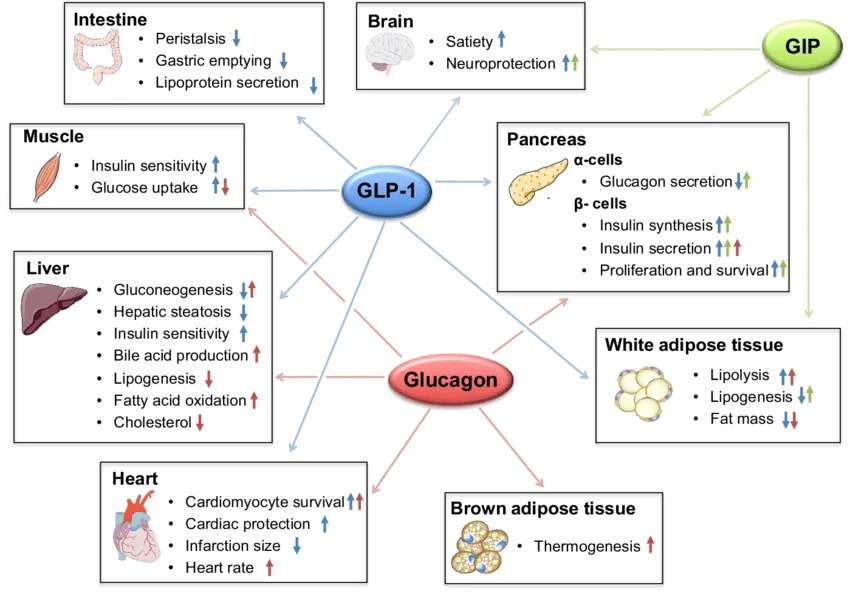
The world of peptide-based therapies is evolving rapidly, and three peptides—semaglutide, tirzepatide, and retatrutide—are at the forefront of clinical and experimental research for their weight loss and metabolic benefits. Each peptide offers distinct mechanisms of action, targeting different pathways in the body. While they all share some similarities, understanding their differences is crucial for determining their potential benefits and side effects.
This article will provide an overview of the key differences between these three peptides, touching on their mechanisms of action, benefits, and how they differ from one another.
Semaglutide is a single agonist that primarily targets the GLP-1 (glucagon-like peptide-1) receptor. It mimics the action of human GLP-1, a hormone that plays a crucial role in regulating blood sugar, appetite, and insulin secretion. Semaglutide is about 94% identical to the human GLP-1 hormone, which explains its high affinity for the GLP-1 receptor—about twofold greater than tirzepatide. This strong binding affinity results in a potent effect on appetite regulation, gastric emptying, and glucose control.
Key benefits of semaglutide include:
However, while semaglutide has a high affinity for the GLP-1 receptor, it does not have effects on other receptors like GIP (Gastric Inhibitory Polypeptide) or glucagon, which can limit its overall effectiveness in other areas such as fat metabolism and energy balance.
Tirzepatide is a dual agonist, meaning it targets both the GLP-1 receptor and the GIP receptor. The GIP receptor plays a role in insulin secretion and fat metabolism, while the GLP-1 receptor primarily influences appetite regulation and glucose control. Tirzepatide combines the benefits of GLP-1 agonism with the effects of GIP agonism, which makes it unique in the peptide landscape.
Tirzepatide is a modified GIP molecule with added GLP-1 activity. While it binds to the GIP receptor with the same affinity as the natural GIP peptide, it binds to the GLP-1 receptor with about 5 times weaker affinity than the body’s natural GLP-1. This creates an imbalanced dual agonist with a stronger effect on GIP than GLP-1.
The benefits of tirzepatide include:
Despite its promise, tirzepatide has a lesser affinity for the GLP-1 receptor compared to semaglutide, meaning it may require higher doses to achieve the same level of GLP-1 agonism.
Retatrutide (Reta Glp-3) takes things a step further by acting as a triple agonist, targeting the GLP-1 receptor, the GIP receptor, and the glucagon receptor (GCGR). This makes it a potent combination that not only influences insulin release and appetite but also plays a significant role in fat metabolism and energy expenditure.
Like tirzepatide, retatrutide is a modified GIP molecule, but it has been altered to also activate the glucagon receptor, which plays a crucial role in regulating blood sugar, heart function, and fat metabolism. Retatrutide is 8.9 times more potent at the GIP receptor than native GIP and 2.9 times less potent than human glucagon at the glucagon receptor.
Key benefits of retatrutide include:
The glucagon receptor component of retatrutide could be the key differentiator, enhancing fat loss and energy expenditure while promoting other benefits such as muscle preservation and cardiovascular health.
Each of these peptides—semaglutide, tirzepatide, and retatrutide—offers distinct advantages depending on the therapeutic or experimental goals. While semaglutide remains a highly effective GLP-1 agonist for appetite regulation and blood sugar control, tirzepatide takes a dual approach, adding GIP agonism to enhance fat metabolism and insulin release. Retatrutide, as a triple agonist, introduces the glucagon receptor into the mix, potentially revolutionizing fat loss, energy expenditure, and cardiovascular benefits.
The choice between these peptides will depend on individual needs, including desired outcomes related to weight loss, fat metabolism, energy levels, and side effect profiles. Researchers and patients alike should consider each peptide’s mechanism of action and consult relevant scientific literature to determine the best option for their specific goals.
As the research on these peptides continues to evolve, more definitive comparisons and conclusions will emerge, providing further insight into their individual and combined benefits.