By Nikita Biryukov
Reprinted with permission
New Jersey Monitor
Gov. Mikie Sherrill, in a bid to offset electricity price increases set to go into effect in June, ordered the Board of Public Utilities on Tuesday to expand bill credits that ratepayers saw last summer and pause proceedings that could approve new rate increases.
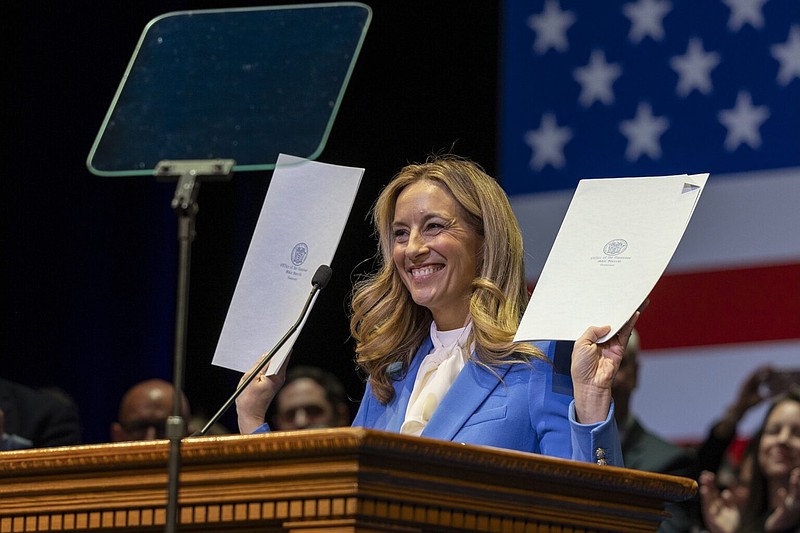
Sherrill signed the orders, her first as governor, on stage during her inauguration at the New Jersey Performing Arts Center in Newark. The Democrat succeeded former Gov. Phil Murphy (D) at noon on Tuesday after campaigning on a promise to order a utility rate freeze on her first day as New Jersey’s chief executive.
“I promised the people of New Jersey bold action to lower utility costs and, today, I’m delivering. Trenton will no longer accept the status quo and kick the can down the road while New Jersey families pay higher bills — not on my watch,” she said in a statement.
It’s unclear how much the credits will shave off ratepayer bills, though their amount is expected to vary depending on a ratepayer’s electricity usage.
The credits would be at least partially funded through a state fee on electricity suppliers unable to meet New Jersey’s renewables standards and the Regional Greenhouse Gas Initiative, a cap-and-trade program that auctions off emission allowances to fossil fuel plants.
Their total cost is unclear. When Murphy unveiled the bill credits to offset energy rate increases last year, they provided ratepayers with $100, plus an additional $150 for low-income utility customers. Murphy administration officials said his program was expected to cost about $430 million. The cost for Sherrill’s credits will likely be far higher.
Her first order directs the Board of Public Utilities to issue its first wave of credits by July 1, 2026.
Other provisions of her order require the board to weigh reducing the societal benefits charge — a 3% surcharge on all New Jersey electricity bills — and retooling the state’s Clean Energy Program to focus on ratepayer relief and energy efficiency programs.
“I’ve heard you, New Jersey: We’re facing an affordability crisis, and you want costs to come down, and you want that to begin today. You don’t want a strongly worded letter, you don’t want a 10- year study, and you don’t want empty words. In short, you are sick of the status quo,” Sherrill said during his inaugural address. “Well, guess what, guys, so am I.”
Other provisions direct regulators to study changes to utilities’ business models.
New Jersey’s regulated utilities — power companies like PSE&G or Jersey Central Power & Light — do not profit off the sale of electricity, which they pass along to customers at cost, but they are permitted to earn a set return on capital investments for transmission and other infrastructure.
In New Jersey, that return on equity is typically about 10%. Regulators could lower those rates in response to Sherrill’s order, which, among other things, asks the Board of Public Utilities to consider multi-year rate plans and additional state review for some transmission projects.
Electricity prices in New Jersey and along the 13-state grid run by PJM Interconnection have soared in recent years as artificial intelligence data centers’ electricity demands squeezed supply after years of low load growth.
The increases include hikes of roughly 20% that went into effect last June as a result of price-setting capacity auctions held by PJM. Another round of increases from more recent capacity auctions is set to take effect in June.
A second order Sherrill signed Tuesday calls on the Board of Public Utilities to speed solicitations for new solar and storage projects and orders a slew of state agencies to identify regulations that could slow the deployment of new power generation for the governor to waive.
“These executive orders will deliver relief to consumers and stop rate hikes, so New Jerseyans aren’t facing ever-increasing electric bills. This will also create the conditions to massively expand New Jersey’s power generation, because more power in-state will help lower costs,” Sherrill said.
It requires the board to develop a policy to identify duplicate interconnection requests filed by large power users, like data centers, filed across states. Some critics have charged that duplicate requests result in phantom demand that bloats load forecasts and increases electricity prices.
It also directs the Department of Environmental Protection to take all steps needed to speed permitting for capacity upgrades, emissions reductions, and efficiency improvements at New Jersey’s gas plants.