By Dana Difilippo
Reprinted with permission
New Jersey Monitor
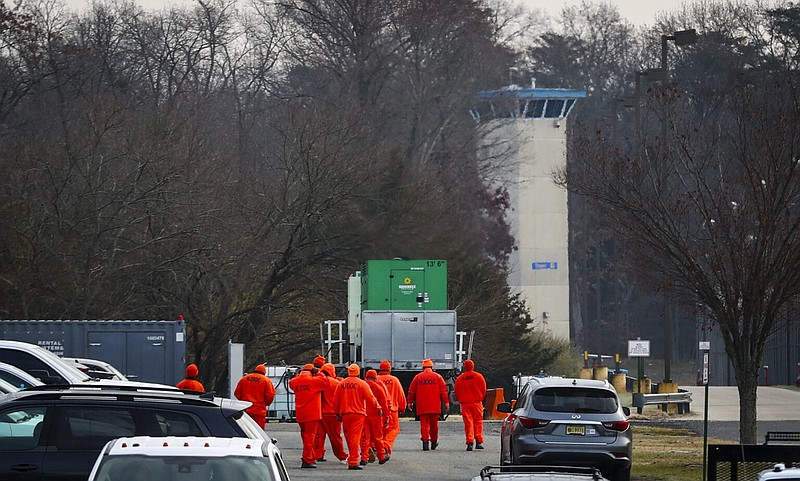
Prisons are supposed to be drug-free spaces, but illicit drugs have become so rampant in New Jersey’s state lockups that staff administered the overdose-reversing drug Narcan more than once a day, on average, in recent years, a new report reveals.
Correctional officers and medical staff used Narcan in 406 separate incidents in the 2025 fiscal year, and 544 times the year before, according to an annual report on prison health care the Department of Corrections released last month. Twenty-two people died of overdoses or “drug-related accidents” between 2018 and 2024, according to the report.
A department spokesman did not respond to a request for comment, but the report’s unnamed author was quick to note that Narcan numbers don’t necessarily indicate a drug overdose.
“Administration of Narcan is based on clinical presentation. Symptoms similar to intoxication may not necessarily be drug-related, but the result of other medical conditions. Staff have been trained to provide Narcan in emergencies as it has no significant harmful side effects,” the report said.
Narcan is typically administered when anyone is found unresponsive, said Terry Schuster, who’s tasked with prison oversight as the state’s corrections ombudsperson. He recently reported on a rise in prison deaths and found that officials had administered Narcan to three people who died of causes unrelated to drugs, including suicide by hanging, asthma, and age-related ailments deemed natural.
“Yes, there’s a lot of drug use, and there are a lot of Narcan administrations,” Schuster said. “It may be notable that the number is large, but it doesn’t necessarily mean there was an overdose every day.”
It also doesn’t mean that the 950 Narcan doses were used on 950 people, said William Sullivan, a correctional officer at East Jersey State Prison who heads the officers’ union.
“When somebody’s overdosing, we use three or four Narcans, sometimes even more when they get back to the infirmary. It just doesn’t work with some of this stuff they take. That’s usually K2 — the synthetic marijuana — but they’ve been lacing it with horse tranquilizer, elephant tranquilizer, fentanyl, all these different tranquilizers and fentanyl-type stuff,” Sullivan said.
Narcan reverses opioid overdoses and does not work on non-opioid substances like K2 or xylazine.
Prison and harm reduction advocates, though, said the numbers warrant a closer look and suggest the system is losing its fight to keep drugs out of prison, three years after the system shifted to a mail-scanning system to foil lawbreakers who smuggle drugs into prison by mail.
Narcan does save lives and carries minimal risk if it’s used on someone whose affliction is not drug-related, said the Rev. J. Amos Caley, an organizer with New Jersey Prison Justice Watch and a pastor at the Reformed Church of Highland Park.
“In one sense, it’s like three cheers to the DOC for considering life-saving interventions,” Caley said. “But I can’t help but ask the question if paper mail and care packages have been more or less summarily denied, how is it that quantities of these illicit drugs are coming into the prison at such rates that somebody can overdose on them?”
Drugs sometimes get smuggled into prison by correctional officers and other staff, as evidenced by several arrests in recent years of guards at both state prisons and county jails. New Jersey has nine state prisons that incarcerate about 13,000 adults, while another 10,000 are in 15 county jails on any given day across the state.
Morgan Thompson, CEO of the nonprofit recovery group Prevention Links, said the number of Narcan administrations in state prisons “certainly sounds like a lot.”
“The alternative would be an overdose number. So the fact that these are Narcan administrations rather than overdoses is encouraging,” Thompson said.
But the numbers raise urgent questions about what’s driving the need for Narcan, she added.
“Is there an increasing amount of drugs making their way into prisons? Or are adulterations in the drug supply creating a situation where there’s more overdoses? Maybe it’s the same quantities of drugs, they’re just more lethal,” Thompson said. “If I was a policymaker, I would want to get to the bottom of what those numbers mean.”
The number show that drugs “are still getting in there, and there should be more investigations on that,” agreed Elizabeth Burke Beaty, founder and CEO of Sea Change Recovery Community Organization.
Administering Narcan to every unresponsive person behind bars also suggests that staff are “very liberal” in their use of Narcan, even though some harm reductionists regard rescue breathing and oxygen as the best first responses to suspected overdoses, Burke Beaty added.
“I don’t think that Narcan should be the first plan of action. That is, to me, a lack of education and a misuse of funds, honestly,” she said.
Corrections officials told state lawmakers during budget discussions last year that the system had 1,374 “suspected intoxication incidents” in 2024. But they said mail-scanning — which expanded to all prisons in January 2025 after a lengthy pilot program — helped slow the flow of drugs into prisons, with the numbers of both suspected intoxication incidents and Narcan administrations falling from 2024 to 2025.
“We’ve had a lot, lot, lot, lot less overdoses since the mail has switched,” Sullivan agreed.
Still, he noted that prison officials cannot inspect legal mail the way they can other mail, and some crafty entrepreneurs have capitalized on that. Online shoppers now can buy K2-laced stationary designed to look like legal paperwork for a few hundred dollars. Prison officials consequently now are testing technology in two prisons that can detect if legal mail has been soaked in liquid drugs, Sullivan said.
That should help further reduce drug overdoses behind bars, Sullivan said. He dismissed the idea that drugs will ever disappear from prison altogether.
“They’re always going to figure it out, and we got to just keep adapting,” he said.
Caley said prison officials should do more to prevent overdoses by tackling the problems that drive people to self-medicate in prison. That includes addressing incarcerated people’s underlying trauma, ensuring easy access to rehabilitation services, and reducing how many people are held in solitary confinement, he added.
Schuster’s office found in a 2023 state watchdog report that prison officials put more than 200 people in isolation in the first four months of 2023 as discipline for drug possession.
“To punish people as a way of treating them for substance use disorders actually contributes to the situations that lead people to use medications like this in the first place,” Caley said.