
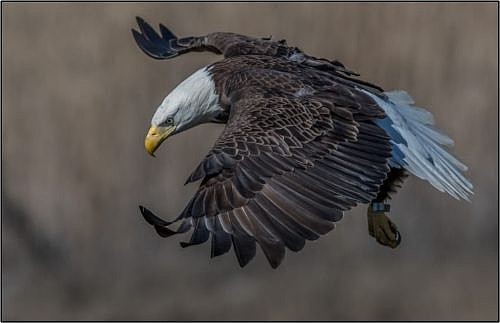
The bald eagle population in New Jersey experienced a slight decline in active nests last year likely due to the impacts of Highly Pathogenic Avian Influenza, according to the annual New Jersey Bald Eagle Project Report released today.
The report, developed by NJDEP Fish & Wildlife with the Conserve Wildlife Foundation of New Jersey, identified 251 nests that produced eggs in 2025, a five percent decrease from 2024, when a record 264 active nests were documented.
“The Department of Environmental Protection’s work to restore New Jersey’s bald eagle population has been so remarkable that the species, once on the brink of extirpation in New Jersey, was removed from the state’s endangered species list last year,” Acting DEP Commissioner Ed Potosnak said in a release. “This success, made possible with the support of countless volunteers over the years, is proof that DEP can deliver against seemingly insurmountable odds. This slight decline in active nests reminds us that we must remain steadfast in our efforts to protect bald eagles for future generations to admire.”
Since the beginning of the U.S. outbreak in January 2022, Highly Pathogenic Avian influenza (HPAI), also called avian influenza or bird flu, has impacted wild and domestic birds in every state. This winter, the wild bird species most impacted in New Jersey has been Canada geese. Outbreaks tend to be seasonal, declining as weather warms and flocks of impacted bird species migrate and disperse.
Impacts of HPAI on Wild Birds
As birds of prey, bald eagles are susceptible to exposure to avian flu by the way they interact with affected bird species. The outbreak of HPAI in the winter of 2024-2025 resulted in large numbers of sick and dying waterfowl, especially snow geese and Canada geese that congregate on reservoirs, lakes and rivers that provide foraging habitat for eagles. Transmission occurs when eagles consume infected birds.
Testing confirmed that 28 of 56 bald eagle mortalities last year (for which testing was completed) were the result of HPAI, an unusually high 50 percent rate. Other causes included vehicle impacts, other trauma, and electrocution on power equipment.
“While there is little that conservation agencies can do to prevent the spread of avian influenza in wild bird populations, NJDEP Fish & Wildlife continues to monitor the situation closely and keep the public informed about its presence in wildlife and our communities,” NJDEP Fish & Wildlife Assistant Commissioner Dave Golden said. “Because bald eagles are particularly susceptible to HPAI transmission, it is vital that the public stay informed and help us protect these majestic birds from human-related threats.”
The DEP encourages the public to report any threats to eagle nests, such as human disturbance or habitat destruction within 1,000 feet of the nest to the DEP at 877-WARNDEP.
A History of Recovery
As of the early 1980s, New Jersey had just one remaining bald eagle nest, a pair in a remote part of Cumberland County. As across the nation, the state’s bald eagle population had been devastated by widespread use of DDT and other threats, including habitat degradation and human disturbances.
Once used widely to control mosquitoes, DDT is a synthetic insecticide that had accumulated in fish that eagles eat, causing thin-shelled eggs that could not withstand incubation. The federal government banned DDT in 1972, marking a pivotal step in the ultimate comeback of the species.
Recovery efforts in New Jersey began in the early 1980s, with reintroduction of eagles from Canada and artificial incubation and fostering efforts that started to pay discernible dividends throughout the 1990s.
Active nests surpassed 100 for the first time in decades by hitting 119 in 2012. Ten years later, the total had more than doubled to 250. In 2024, New Jersey boasted a record 293 nesting pairs of bald eagles, of which 264 laid eggs.
The federal government removed the bald eagle from its list of endangered species in 2007, reflecting strong gains in the population throughout the nation. In January 2025, New Jersey changed the conservation status of the bald eagle from endangered to species of special concern, reflecting a determination that the species’ survival in the state is no longer in jeopardy.
2025 Bald Eagle Survey in Detail
The DEP and Conserve Wildlife Foundation, supported by a network of dedicated volunteer nest-watchers, monitored a total of 298 territorial eagle pairs in 2025. This number includes the 251 pairs that had active nests as well as 47 pairs that maintained nest territories but did not lay eggs.
Of the 234 nests for which offspring outcomes are known, 71 percent were successful and collectively produced 271 offspring. The productivity rate for nests with known outcomes was 1.16 young per nest, which is lower than usual but slightly above the range required to maintain a population. Of the 234 nests with known outcomes, 29 percent failed to produce any young, which is higher than New Jersey’s ten-year average of 20 percent nest failure rate.
For more information about the New Jersey Bald Eagle Project, visit the DEP’s website at https://dep.nj.gov/njfw/wildlife/raptors-in-new-jersey/#eagle.
The Conserve Wildlife Foundation of New Jersey provides information on its eagle program at http://www.conservewildlifenj.org/protecting/projects/baldeagle/.